
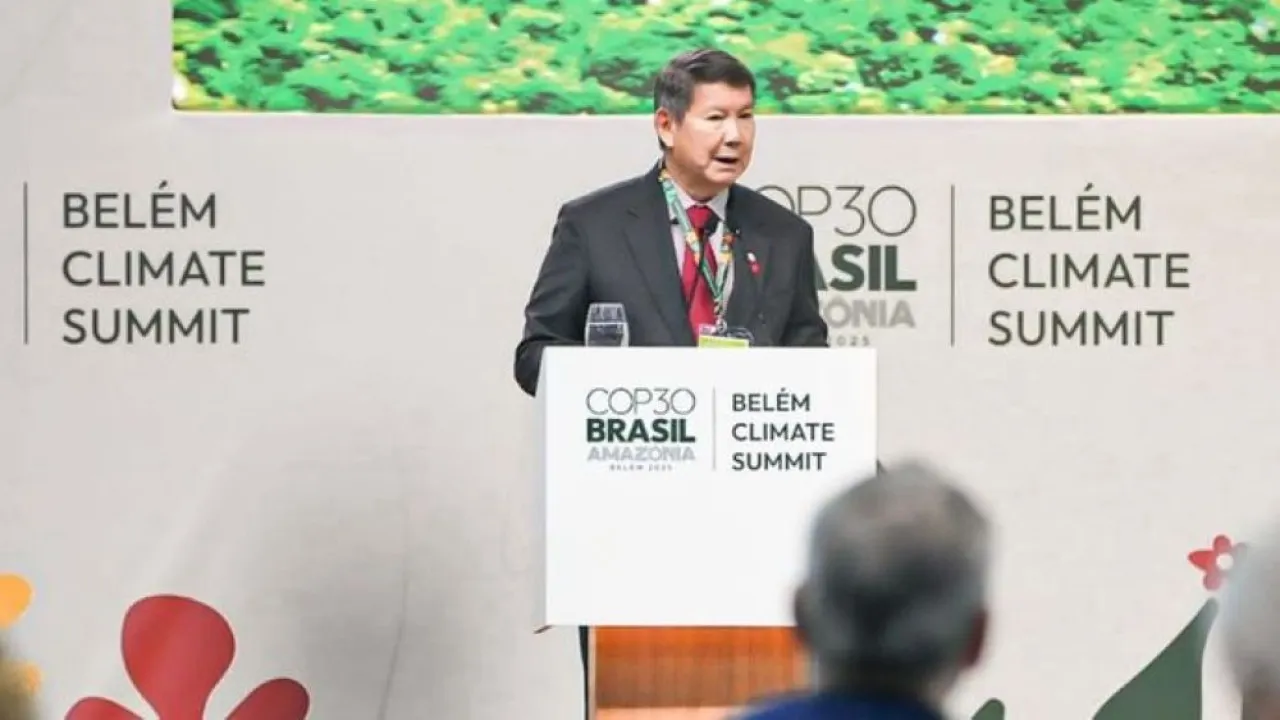
Source: Photo by Nusantara Tv
People’s Climate Justice Alliance. Belém, Brazil, November 7, 2025
Editor’s Note
This dispatch from Belém captures civil society’s reaction to Indonesia’s speech at the Leaders Summit COP30, where green rhetoric collides with extractive realities.
When “Net Zero” Meets Fossil Subsidies
When Indonesia’s Special Envoy for Climate and Energy, Hashim Djojohadikusumo, delivered the country’s statement at COP30, it sounded familiar: “Net Zero by 2060 or sooner,” “growth at 8%,” and “energy transition led by innovation.”
But for civil society, it was déjà vu, a polished script masking old contradictions.
Indonesia continues to pour IDR 500 trillion annually into fossil-fuel subsidies, even as it promotes “transition.” For the Aliansi Rakyat untuk Keadilan Iklim (ARUKI), this is not leadership it’s climate hypocrisy.
“The President’s envoy gave a green stage performance a climate theatre hiding a pro-business agenda,” said Torry Kuswardono, Executive Director of Yayasan Pikul.
False Solutions, Real Exploitation
Indonesia’s speech celebrated “waste-to-energy,” “biofuels,” and “nuclear power” as clean solutions. But according to ARUKI, these are false solutions that displace communities and deepen inequality.
“Projects like geothermal in Poco Leok and large-scale biofuel plantations have caused land grabbing, evictions, and loss of livelihoods,” Torry continued. “This is not energy transition it’s ecological dispossession.”
Behind the promise of “green growth” lies a familiar pattern: corporate profit over people, extraction disguised as innovation.
FOLU Net Sink: Offset or Deception?
Indonesia proudly presented its FOLU Net Sink 2030 plan as proof of progress.
Yet, activists argue it is nothing more than a massive offset scheme, allowing corporations to keep polluting by buying forest-based credits.
“FOLU Net Sink is not a real emission-reduction mechanism it’s an offset system for corporate polluters,” said Uli Arta Siagian, Forest Campaigner at WALHI.
She explained that despite government claims of a “75% drop in deforestation,” forest clearance continues legally under National Strategic Projects for mining and plantations. “It’s a climate scam dressed in green,” she added.
Patriarchy and Policy: The Gender Gap in Climate Leadership
ARUKI’s statement also echoed the critique from Solidaritas Perempuan, who described the government’s approach as a reflection of patriarchal power in climate governance.
“Indonesia’s climate policies are driven by extractive economics that systemically impoverish women and vulnerable groups,” said Armayanti Sanusi, Chair of the National Executive Body of Solidaritas Perempuan.
She underlined that Indonesia has failed to integrate the Gender Action Plan into national climate policy, and continues to treat climate finance as investment debt, not justice.
“Projects focus on finance and technology transfers, not real action, adding to Indonesia’s climate debt burden,” she concluded.
Voices from Below: The People’s Mandate
The Indonesia Climate Justice Summit (ICJS) 2025 gathered voices from farmers, fishers, Indigenous peoples, youth, women, workers, and people with disabilities across 13 regions. Their message, delivered through ARUKI, is clear:
Reject all false-solution schemes — including carbon offsets, FOLU Net Sink, NEK, blue-carbon projects, and large-scale extractive energy.
Redirect fossil subsidies — trillions of rupiah must fund community-based, just-energy transitions.
Pass the Indigenous Peoples Bill and Climate Justice Bill — to ensure legal protection for communities and women at the frontlines.
On the global stage, ARUKI urges Indonesia to demand new and fair climate finance (NCQG) based on grants, not loans, and to establish a Loss and Damage Fund accessible directly to affected communities, protected by civic space and free from criminalisation of Environmental Human Rights Defenders (EHRDs).
“Climate justice is not a business compromise. It is the people’s right,” the statement closes.
Beyond the Podium
As COP30 enters its critical week, Indonesia stands at a crossroads:
Continue the performance or begin a transformation.
The people have spoken through ARUKI:
Justice, not offsets. Transition, not trade.
Source
Press Release: Aliansi Rakyat untuk Keadilan Iklim (ARUKI), Pidato Indonesia di COP30: Sandiwara Hijau Tutupi Solusi Palsu, Agenda Perampasan Lahan, dan Pengabaian Keadilan, 7 November 2025