
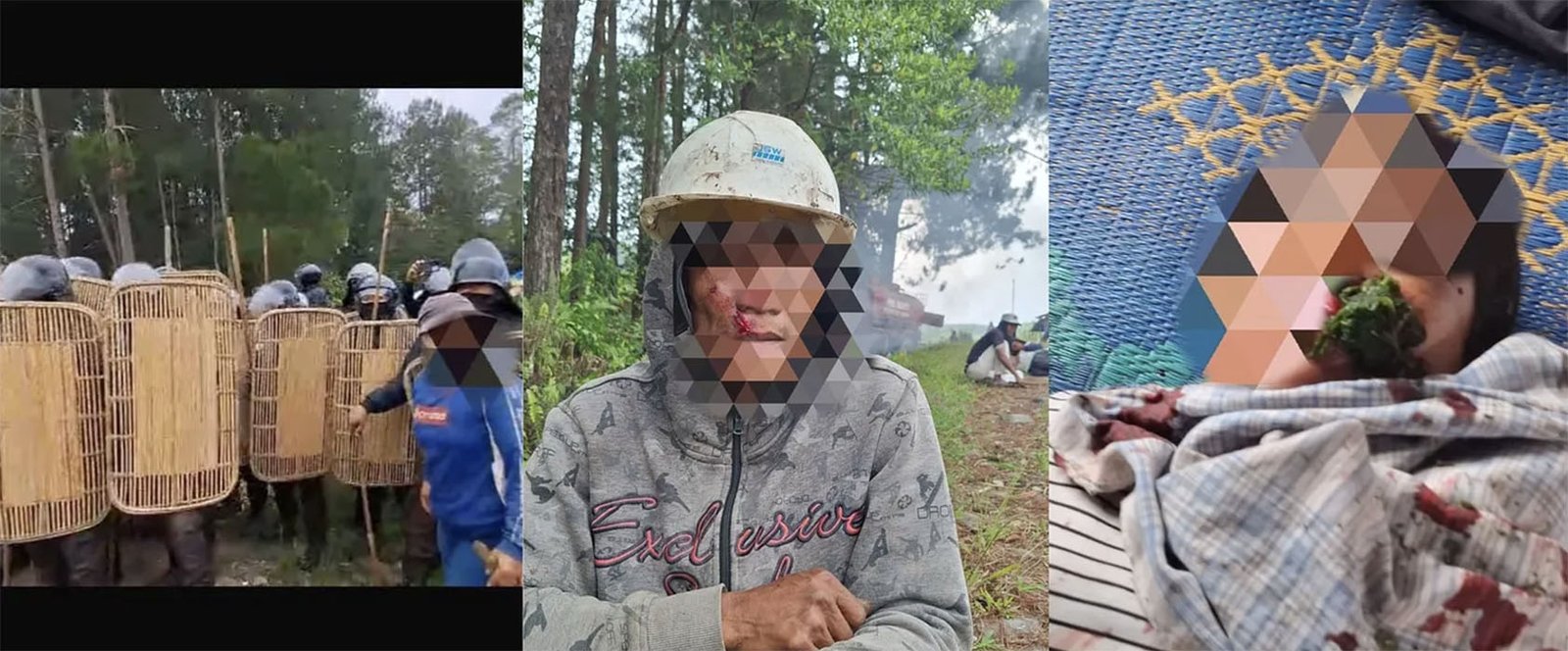
“Injured indigenous women and elders after the attack by PT Toba Pulp Lestari security in Sihaporas, highlighting the human cost of unresolved land conflicts.” Source Instagram @rumah.aman
On Monday morning, 22 September 2025, Sihaporas once again witnessed a dark chapter. Hundreds of workers and security personnel from PT Toba Pulp Lestari (TPL) stormed the Buntu Panaturan farmland in Sihaporas Village, Pematang Sidamanik District, Simalungun, North Sumatra. Just two to three kilometers away from Lake Toba, this area suddenly turned into a battleground between corporate guards and Indigenous communities.
Dressed in black uniforms and carrying full gear curved machetes, stun devices, wooden sticks, rattan shields, visored helmets, and military boots the convoy arrived in seven trucks and three private cars. Upon reaching the site, they immediately attacked Indigenous residents who had been standing guard at the Buntu Panaturan post.
Most of the victims were women. Video footage shows a mother, DL (34), bleeding from facial wounds. Other identified victims include SA (63), PS (55), and ES (44). By midday, TPL personnel remained stationed at the site, creating an atmosphere of fear and intimidatio
An Agrarian Conflict Without End
The “Bloody Sihaporas” incident is not the first of its kind. For decades, Indigenous communities around Lake Toba have endured relentless pressure from TPL’s concession claims. Since the era of industrial forest concessions, local residents have repeatedly faced unilateral land grabs that strip away their ancestral territories.
As in many agrarian conflicts across Indonesia, the root cause is structural: a deeply unequal distribution of land. Corporations are granted expansive concessions by the state, while Indigenous peoples who have lived on the land for generations are treated as outsiders in their own homeland.
The rhetoric of development, investment, and job creation is often used as justification. Yet on the ground, the reality is starkly different: communities lose their land, women bear the brunt of violence, and social cohesion fractures under prolonged conflict.
Public Outcry: Return the Land, End the Violence
The 22 September assault immediately sparked a wave of responses on social media. The hashtag #TutupTPL (“Shut Down TPL”) resurfaced, accompanied by widespread condemnation. Advocacy accounts such as @rumah.aman and @tanahuntukrakyat reiterated the core demands: resolve agrarian conflicts, return Indigenous territories, and end corporate-led violence.
Public comments reflected both anger and despair:
“Such cruelty against our fellow countrymen is unbearable.”
“Do not become wolves against your own brothers.”
“For how many years has this case gone unresolved? Are officials turning a blind eye to corporate power?”
Many users went further, tagging senior state officials from the President and Chief of Police to the Minister of Defense demanding concrete action.
A State at the Crossroads
The tragedy in Sihaporas lays bare the fragility of the state in protecting its own citizens. The Constitution clearly mandates recognition and protection of Indigenous peoples’ rights to their ancestral lands. Yet in practice, state apparatus often appear quicker to defend corporate interests than to safeguard their people.
This persistent failure to resolve agrarian conflicts also undermines Indonesia’s credibility on the global stage. How can Indonesia claim leadership in climate diplomacy when it continues to allow its Indigenous peoples to be dispossessed and assaulted in their own territories?
From Lake Toba to COP30
In 2025, the world is looking toward COP30 in Belém, Brazil, as a critical moment for advancing climate justice. This summit is not only about emission targets or energy transitions, it is also about recognizing the role of Indigenous peoples in protecting forests and ecosystems.
The case of Sihaporas offers a powerful reminder: there can be no climate justice without agrarian justice. What is the point of talking about renewable energy or emission reductions if, at the same time, Indigenous communities at home are beaten and silenced in the name of extractive industries?
From Lake Toba to the Amazon, the pattern is the same: Indigenous voices are marginalized while corporations are empowered. COP30 must become a turning point, ensuring that Indigenous communities are no longer silenced but are instead positioned as central actors in global climate action.
The Way Forward
Sihaporas must not be seen as an isolated local incident. It is a symbol of Indonesia’s agrarian crisis. The bloodshed on Toba’s ancestral land is a stark warning that development without social justice will only produce violence.
The rallying cries on social media #TutupTPL and #ResetKetimpanganAgraria (“Reset Agrarian Inequality”) are not just slogans. They are urgent calls to end the long history of land grabbing and repression of Indigenous peoples.
The choice now lies with the state:
Will the government continue to allow corporations to run rampant?
Or will it finally take bold steps to restore Indigenous rights and fulfill the promise of agrarian justice?
Sihaporas is waiting for an answer. And so are we, as a nation.